
Fanless Industrial PC Guide: Cooling & Benefits
Learn how fanless industrial PCs work, their cooling and reliability benefits, and how to select the right model for factory automation.
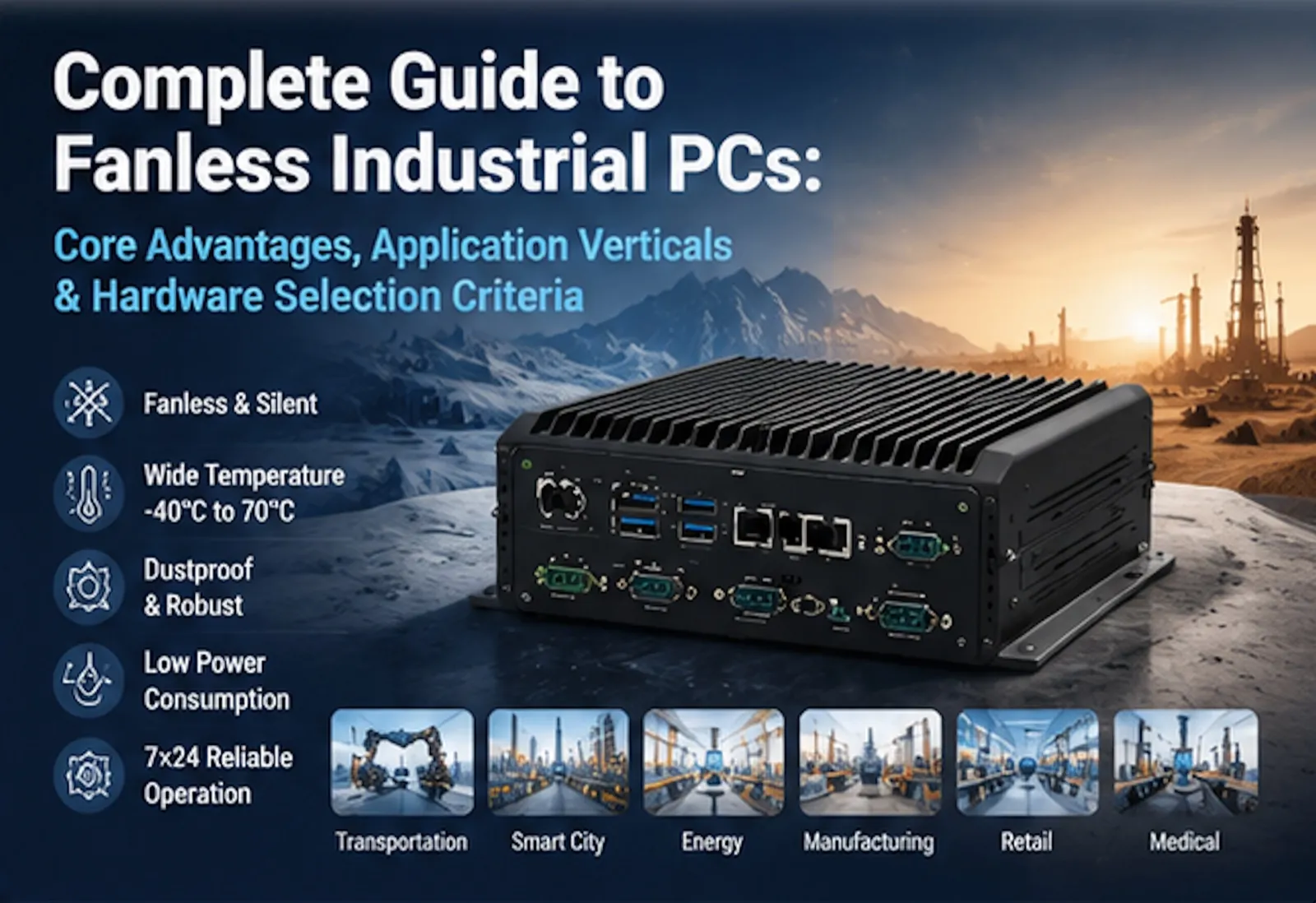
Within industrial field deployments, consistent hardware reliability consistently outweighs raw peak computing performance. Factory production floors, automated control systems, machine vision inspection equipment and edge computing gateways all demand computing hardware capable of stable continuous operation amid airborne dust, mechanical vibration, extreme temperature swings and heavy electromagnetic interference.
Fanless Industrial PCs represent a specialized hardware category engineered specifically to address these harsh environmental challenges, eliminating traditional mechanical cooling fans entirely in favor of fully passive thermal dissipation architectures.
Fanless industrial computing hardware sees widespread deployment across:
- End-to-end factory automation assembly lines
- High-speed machine vision quality inspection stations
- Cross-factory Industrial IoT (IIoT) data gateways
- GPU-accelerated edge AI real-time inference hardware
- Fixed articulated industrial robotic control systems
- CNC precision machining equipment HMI controllers
- Railway rolling stock on-board monitoring hardware
- Remote renewable energy generation monitoring infrastructure
IPCtech is a leading global manufacturer of industrial computing hardware, supplying fanless box PCs, compact embedded industrial controllers, touchscreen Panel PCs and fully customized industrial computing solutions for worldwide industrial automation clients.
What Exactly Is a Fanless Industrial PC?
A Fanless Industrial PC is a specialized industrial computing system utilizing 100% passive heat dissipation architectures with zero mechanical cooling fans. Traditional commercial and entry-level industrial PCs rely on spinning plastic fans to force convective air flow and expel internal component heat. Fanless industrial hardware instead leverages three core passive heat transfer mechanisms:
- Direct conductive thermal transfer through solid metal chassis
- Integrated heavy-duty extruded aluminum heat sink enclosures
- Optimized internal thermal layout engineering to evenly spread component heat across exterior chassis surfaces
The resulting hardware platform delivers unmatched long-term operational stability designed exclusively for multi-year continuous industrial deployment cycles.
How Do Fanless Industrial PCs Dissipate Heat Without Cooling Fans?
A primary common technical question from engineering buyers: “How can fanless industrial computers regulate internal temperatures without cooling fans?” The solution lies in fully passive thermal management architecture built on three core design pillars:
1. Integrated Aluminum Alloy Heat Spreader Chassis
The entire outer metal enclosure of the fanless PC doubles as a large-scale passive radiator. Heat generated internally by high-power components including:
- Central Processing Unit (CPU)
- System Memory RAM modules
- Motherboard chipset controllers
- Optional GPU acceleration cards is conductively transferred outward across the full surface area of the aluminum chassis for natural ambient air cooling.
2. High-Conductivity Thermal Interface Materials
Premium thermal gap pads and thermal paste compounds create seamless high-efficiency heat transfer bridges between heat-generating internal electronics and the exterior aluminum chassis spreader.
3. Low-Power Industrial-Grade Component Selection
Nearly all fanless industrial hardware platforms utilize energy-efficient low-wattage processors to minimize baseline heat generation:
- Intel Celeron low-power embedded CPUs
- Intel Core low TDP industrial processors
- ARM architecture low-power embedded system-on-chips
Reduced baseline power draw drastically cuts total thermal output, making full passive cooling architecture operationally viable without mechanical fans.
Comparative Table: Fanless Industrial PC vs Fan-Cooled Computing Hardware
| Hardware Characteristic | Fanless Industrial PC | Fan-Cooled Standard Computer |
|---|---|---|
| Primary Thermal Architecture | Fully Passive Conduction Cooling | Mechanical Forced-Air Fan Cooling |
| Moving Mechanical Components | Zero spinning cooling fan assemblies | High-wear fan motor and bearing units |
| Dust & Contaminant Resistance | Excellent ingress protection | Poor dust resistance via intake air flow |
| Routine Maintenance Requirement | Minimal long-term upkeep | Regular fan cleaning and replacement cycles |
| Acoustic Noise Emission | Fully silent zero-noise operation | Constant audible fan operational hum |
| Target Operating Environment | Rugged industrial hostile field deployments | Controlled clean office ambient spaces |
Core Strategic Advantages of Deploying Fanless Industrial PCs
1. Dramatically Improved Long-Term Operational Reliability
The single greatest functional benefit of fanless hardware design is eliminating the most prevalent mechanical failure point in industrial computing systems: cooling fans. Cooling fan assemblies degrade and suffer catastrophic failure due to cumulative exposure to:
- Buildup of airborne factory dust and oily particulate matter
- Natural wear of fan motor ball bearings over thousands of runtime hours
- Non-stop 7×24 continuous year-round industrial operation cycles
- Extreme temperature fluctuation and high-vibration production floor environments
By removing spinning fan hardware entirely, fanless industrial PCs deliver drastically reduced hardware failure risk across multi-year continuous deployment lifecycles.
2. Superior Dust & Contaminant Ingress Resistance
Standard factory production environments generate consistent airborne contaminants including:
- Fine metal cutting shavings
- Machine lubricant oil mist vapor
- Dry plastic and wood manufacturing dust particulate
- Process chemical airborne residue
Fan-cooled hardware continuously pulls contaminated ambient air through internal chassis via intake vents to maintain cooling, drawing abrasive particulate matter onto sensitive circuit boards and electronic components over time. Fanless passive cooling systems eliminate forced air intake entirely, drastically reducing particulate contamination buildup inside the chassis and extending overall hardware service life.
Primary high-contamination deployment use cases:
- Metal fabrication manufacturing workshops
- CNC precision machining production lines
- Automated food packaging processing equipment
- Continuous-running consumer goods assembly lines
3. Optimized for Uninterrupted 7×24 Industrial Runtime
Virtually all industrial automation workflows mandate year-round non-stop hardware operation with zero unplanned downtime:
- Continuous automated assembly production lines
- Real-time visual quality inspection monitoring stations
- Cross-site industrial IoT centralized surveillance infrastructure
Fanless industrial PCs are engineered from the ground up for consistent stable performance over thousands of continuous runtime hours with minimal required maintenance intervention.
4. Fully Silent Zero-Noise Continuous Operation
Passive fanless cooling architecture eliminates all audible mechanical fan hum and vibration noise, enabling deployment within acoustic-sensitive facility environments including:
- Precision scientific laboratory measurement equipment
- Medical diagnostic and therapeutic hardware integration
- Hybrid office-production industrial control rooms
- Ultra-low-noise precision semiconductor manufacturing cleanrooms
5. Compact Form Factor & Flexible Multi-Mount Installation
Fanless industrial PCs feature highly condensed compact chassis footprints optimized for space-constrained integration scenarios:
- Tight industrial electrical control cabinet enclosures
- Narrow machine-side operator control panels
- Miniaturized embedded equipment integration housings
- Any field deployment with severely limited available physical mounting space
Primary Vertical Application Scenarios for Fanless Industrial PCs
Fanless PCs for Factory Automation Control
Factory automation deployments demand computing hardware capable of seamless bi-directional communication with production machinery and PLC logic controllers. Mandatory hardware requirements for automation workloads:
- Uninterrupted long-term runtime stability
- Native multi-protocol industrial communication I/O ports
- Fully configurable expandable digital I/O peripheral capacity
- Multi-year stable component supply lifecycle guarantees
Core automation use cases:
- Standalone automated machinery motion control logic
- Centralized real-time production performance monitoring
- Cross-factory sensor data acquisition aggregation gateways
- Segmented industrial control network routing hardware
Fanless PCs for High-Speed Machine Vision Inspection
Machine vision quality control systems impose strict performance demands on core computing hardware to execute:
- Real-time high-resolution multi-frame image processing
- Automated dimensional measurement and surface defect detection
- Low-latency closed-loop production line sorting logic
Non-negotiable hardware specifications for vision workloads:
- Sustained consistent high-throughput processing capability
- Simultaneous multi-industrial-camera high-bandwidth connectivity
- Hard low-jitter real-time data processing performance
- Reliable 7×24 continuous operation without unplanned downtime
IPCtech fanless industrial computing hardware supports complete machine vision workflows via integrated high-speed USB 3.0 interfaces and multi-port Gigabit Ethernet LAN for GigE Vision industrial camera integration, paired with industrial-grade long-term runtime stability.
Fanless Edge AI Computing Hardware for Smart Manufacturing
Modern digitalized manufacturing facilities migrate heavy data analysis and AI inference workloads to local on-site edge hardware to eliminate latency introduced by cloud-based remote processing. Edge fanless industrial PCs enable localized on-premises computing delivering:
- Near-zero-latency real-time autonomous production decision-making
- Offline AI inference functionality independent of stable internet connectivity
- Continuous streaming sensor data analysis without centralized cloud bandwidth overhead
Primary edge AI industrial use cases:
- AI algorithm-powered automated surface defect visual inspection
- Equipment vibration analytics for predictive failure maintenance
- Fully autonomous smart factory production orchestration control
Fanless PCs for CNC Precision Machining Equipment
CNC machine shop deployment environments expose computing hardware to persistent challenges including:
- Heavy airborne metal cutting dust and coolant oil mist
- Continuous mechanical spindle vibration during machining cycles
- Mandatory legacy RS232 / RS485 serial communication integration
Key required hardware features for CNC integration:
- Multiple isolated COM serial communication ports
- Wide-range DC industrial power input tolerance
- Reinforced anti-vibration mechanical chassis construction
Fanless PCs for Autonomous Robotics & AGV Intralogistics
Industrial robotic automation deployments demand three core hardware capabilities:
- Hard real-time low-latency computing processing
- Stable multi-protocol fieldbus communication links
- Ultra-compact footprint for tight robot chassis integration
Fanless industrial computing hardware serves as core motion and perception controllers for:
- Fixed articulated industrial robot arm assemblies
- Warehouse autonomous guided vehicle (AGV) fleets
- Fully automated material handling intralogistics systems
Critical Hardware Parameters to Evaluate When Sourcing Fanless Industrial PCs
1. Central Processing Unit (CPU) Performance Tiering
Match processor performance strictly to target application workload requirements; IPCtech offers two core CPU product tiers:
Intel Celeron Low-Power Embedded CPUs
Optimized for:
- Basic standalone factory automation control logic
- Lightweight cross-factory sensor data collection gateways
- Low-bandwidth Industrial IoT edge connectivity hardware
Intel Core Mid/High-Tier Industrial CPUs
Optimized for:
- Multi-camera high-speed machine vision inspection systems
- GPU-accelerated edge AI real-time inference workloads
- High-throughput multi-tasking industrial computing deployments
2. Native Industrial Communication I/O Interface Portfolio
Audit all required peripheral connectivity ports prior to hardware selection:
Serial Communication Interfaces
- RS232 standard serial ports
- Isolated RS485 / RS422 differential serial fieldbus ports
Network Communication Interfaces
- Dual isolated Gigabit Ethernet LAN ports
- Multi-port high-bandwidth Gigabit LAN configurations
Digital Control Peripherals
- Isolated GPIO general digital input/output terminals
- Hardware CAN Bus fieldbus controller headers
3. Hardware Expandability & Add-On Capacity
High-complexity industrial automation and vision workloads frequently require peripheral expansion hardware:
- PCIe expansion slots for GPU acceleration or fieldbus add-in cards
- M.2 internal expansion slots for Wi-Fi/5G cellular communication modules
- Extra high-speed USB 3.0 ports for multi-camera vision integration
4. Environmental Ruggedization & Ingress Protection
For extremely harsh contaminated or temperature-fluctuating field deployments, prioritize these hardware specifications:
- Extended wide operating temperature range support
- Full-system water-resistant sealed enclosure design
- High-grade dustproof passive cooling chassis construction
- Reinforced anti-vibration mechanical chassis framing
Common industrial ingress protection rating tiers:
- IP65 front-panel dust/water spray resistance
- IP66 full-chassis high-pressure water jet washdown protection
- IP67 temporary full submersion resistance for extreme outdoor deployments
5. Storage Media & Long Lifecycle Supply Requirements
Nearly all multi-year industrial automation projects mandate consistent stable hardware platforms:
- Industrial-grade shock-resistant SSD solid-state storage media
- Multi-year guaranteed continuous component supply from the manufacturer
Evaluation Criteria for Selecting a Reliable Fanless Industrial PC Manufacturer
A trusted industrial computing hardware supplier must demonstrate four core capability pillars:
1. End-to-End Manufacturing Production Capacity
Proven internal manufacturing capabilities covering:
- Custom hardware mechanical design & prototyping
- Rigorous multi-stage quality control testing workflows
- Scalable small-batch and mass-volume order production lines
2. Comprehensive Customization Engineering Services
Full support for tailored project-specific hardware modifications:
- Complete internal hardware circuit layout customization
- Custom industrial I/O port layout and peripheral configuration
- Bespoke mechanical enclosure chassis redesign
3. Vertical Industrial Application Domain Expertise
Demonstrated engineering experience across key industrial verticals:
- Automated factory control system integration
- Multi-camera machine vision inspection hardware development
- Low-latency edge AI real-time inference platform design
4. Long-Term Post-Sales Hardware Lifecycle Support
Industrial automation projects require consistent multi-year hardware continuity support:
- Fixed unchanging hardware platform component supply guarantees
- Formal legacy spare parts stocking commitments post EOL
- Global multi-tier remote and on-site technical support service
Core Competitive Advantages of IPCtech Fanless Industrial PCs
IPCtech specializes in end-to-end industrial computing hardware development, full product portfolio including:
- Compact fanless box PC passive-cooled controllers
- Miniature embedded fanless industrial computing hardware
- Touchscreen fanless industrial Panel PC HMI systems
- High-performance GPU-accelerated edge AI fanless computing platforms
IPCtech fanless passive-cooled industrial computing hardware is purpose-built for core vertical deployment scenarios:
- Continuous-running factory automation assembly line control
- Multi-camera high-speed machine vision quality inspection
- Fully digitalized smart manufacturing infrastructure edge gateways
- Autonomous industrial robotic motion control hardware
- Cross-site Industrial IoT sensor data acquisition aggregation
With full industrial-grade ruggedized mechanical design engineering capability and flexible ODM custom hardware modification support, IPCtech enables global B2B industrial integration clients to deploy ultra-reliable passive-cooled computing platforms for the most demanding harsh industrial field environments.
Supplementary Fanless Industrial PC FAQ
Are fanless industrial PCs sufficiently reliable for continuous factory deployment?
Yes. Fanless hardware design eliminates cooling fans, one of the most common mechanical failure points in industrial computing hardware, drastically improving long-term operational stability within contaminated, vibrating factory environments.
How do fanless industrial PCs dissipate internal heat with zero cooling fans?
Fanless industrial computing hardware relies entirely on passive thermal transfer architecture including thick aluminum alloy integrated heat spreader chassis, high-performance thermal interface materials and low-power embedded industrial processors minimizing baseline heat generation.
Are fanless passive-cooled PCs suitable for direct factory floor deployment?
Absolutely. Fanless hardware delivers superior dust contamination resistance, drastically reduced routine maintenance overhead and consistent stable continuous runtime performance, making it the optimal hardware choice for standard manufacturing shop floor deployments.
Can fanless industrial PCs sustain uninterrupted 7×24 year-round operation?
Yes. All IPCtech fanless industrial computing hardware is engineered from the ground up specifically for non-stop 7×24 continuous industrial production workload operation.
What differentiates a fanless PC from a general industrial PC?
“Fanless PC” describes a hardware thermal cooling architecture utilizing passive heat dissipation with zero spinning cooling fans, while the broader term “Industrial PC” refers to any computing hardware engineered for rugged industrial field deployment, encompassing both fan-cooled and fanless chassis variants with reinforced environmental protection and native industrial communication I/O ports.
What primary industrial verticals deploy fanless passive-cooled computing hardware?
Most widespread application scenarios include:
- Continuous-running factory automation control systems
- Multi-camera machine vision quality inspection stations
- Autonomous industrial robotic and AGV intralogistics control hardware
- GPU-accelerated edge AI real-time inference gateways
- CNC precision machining equipment HMI control panels
- Railway rolling stock and remote energy monitoring infrastructure