
Industrial PC vs Commercial PC: Key Core Differences
Industrial PC vs commercial PC: reliability, wide temperature, lifecycle, and I/O compared - and how to choose the right platform for manufacturing.
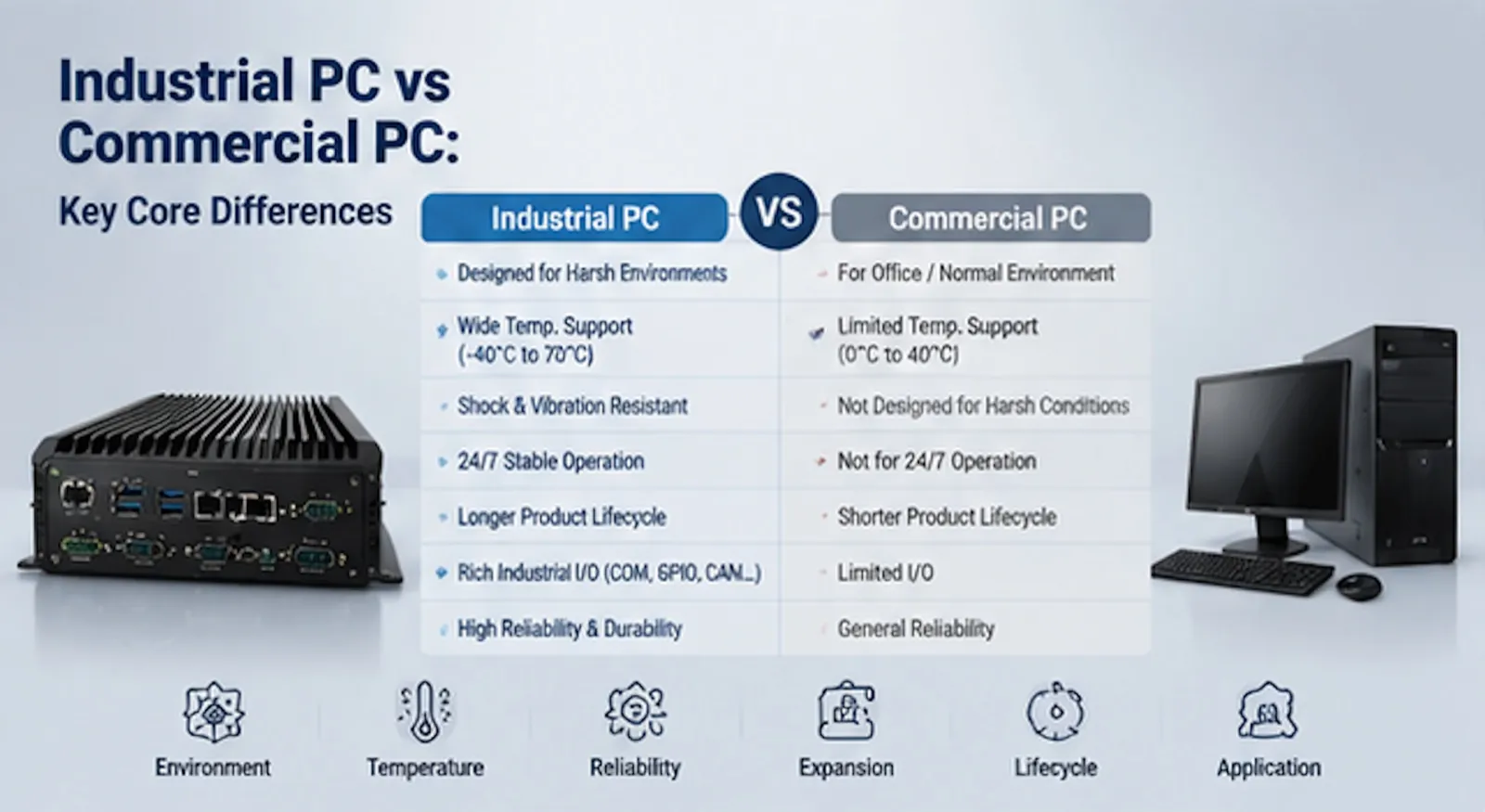
When engineering and procurement teams source computing hardware for industrial deployments, one core question repeatedly arises: What separates an industrial PC from a standard commercial desktop PC? While both hardware categories deliver general computing processing capability at first glance, they are engineered for entirely distinct operating environments and functional priorities.
Commercial PCs are optimized for office, education and personal consumer computing workloads. Industrial PCs are purpose-built for factory floors, automated production machinery and harsh industrial environments where consistent reliability, continuous uptime and long-term hardware support are non-negotiable requirements.
Industrial PC vs Commercial PC: Key Differences at a Glance
- Designed for 7×24 continuous operation
- Wide temperature range, typically -20°C to 70°C or wider
- IP50–IP68 dust and water protection options
- Native RS232 / RS485 / CAN / GPIO industrial I/O
- 5–7 year component lifecycle supply commitment
- Vibration and shock resistant, MIL-STD-810G tested
- Intermittent daily office use
- Typical 0°C to 40°C operating range
- No dedicated dust or water protection
- USB / HDMI mainstream ports only
- 1–2 year hardware replacement cycle
- No anti-vibration mechanical reinforcement
What Is a Commercial PC?
Commercial PCs are universal computing devices designed for routine daily office tasks. Typical use cases include:
- Corporate administrative office work
- Web browsing & general internet access
- Document editing and spreadsheet processing
- Media entertainment consumption
- Lightweight standard software applications
Commercial hardware is engineered to prioritize:
- Low upfront unit cost
- Mass market widespread availability
- Short hardware replacement lifecycles
- Balanced general-purpose performance
Common examples:
- Standard office desktops
- Consumer laptops
- Entry-level mini PCs
However, commercial hardware is generally unsuitable for:
- 7×24-hour uninterrupted continuous operation
- Extreme high/low temperature environments
- Dusty, oily production floors
- High-vibration industrial machinery integration
What Is an Industrial PC (IPC)?
An Industrial PC (IPC) is a specialized computing system engineered exclusively for stable operation within harsh industrial environments where standard commercial hardware cannot maintain consistent functionality.
Industrial PCs are widely deployed across:
- Factory automation assembly lines
- Machine vision quality inspection systems
- Autonomous industrial robotics
- Smart manufacturing digitalization
- Industrial IoT (IIoT) data acquisition
- Edge real-time computing
- Railway, new energy and transportation monitoring systems
In contrast to consumer commercial hardware, all industrial PC design revolves around four core priorities:
- Long-term operational reliability & uptime stability
- Extended multi-year product lifecycle hardware support
- Native industrial communication peripheral compatibility
- Ruggedized construction for hostile operating environments
Core Comparative Differences Between Industrial PCs & Commercial PCs
1. Target Operating Environments
The most fundamental divide separating the two hardware types lies in their designed deployment environments. Commercial PCs are built exclusively for:
- Climate-controlled clean corporate offices
- Stable narrow ambient temperature bands
- Low-vibration, dust-free indoor spaces
Industrial PCs are engineered to withstand:
- Unregulated manufacturing shop floors
- Continuous-running automated production lines
- Uncovered outdoor monitoring equipment housings
- Direct integration onto heavy industrial machinery
Industrial field conditions regularly expose hardware to:
- Airborne dust, metal shavings and machine oil mist
- Severe temperature fluctuations from heat-generating production equipment
- Persistent mechanical vibration and physical impact
- Heavy electromagnetic interference (EMI) from motors, inverters and high-voltage equipment
These demanding environmental parameters require drastically reinforced hardware design for industrial-grade computing platforms.
2. Reliability & Support for 7×24 Continuous Runtime
Virtually all industrial automation deployments demand non-stop computer operation with zero unplanned downtime. Real-world examples:
- Round-the-clock automated assembly production lines
- Continuous visual quality inspection stations
- Uninterrupted warehouse logistics automation
- 24/7 railway track monitoring infrastructure
Industrial PCs are purpose-engineered for:
- Full 7×24 non-stop operation year-round
- Consistent long-term stability without frequent maintenance
- Minimized hardware failure risk to avoid costly production line halts
Commercial PCs are designed only for intermittent daily human usage and will rapidly degrade or experience random failure if subjected to continuous industrial round-the-clock operation.
3. Thermal Cooling Architecture
Temperature regulation represents another critical design divergence point between the two hardware classes. Standard commercial computers rely entirely on:
- Low-cost plastic cooling fans
- Minimal basic consumer-grade passive heat sinks
Industrial-grade PCs frequently utilize:
- Fanless fully passive thermal dissipation systems
- Heavy-duty aluminum alloy chassis acting as integrated heat spreaders
- Optimized industrial thermal layout engineering
Key Benefits of Fanless Industrial PC Cooling
Fanless industrial computing hardware delivers multiple operational advantages:
- Eliminates a primary mechanical failure point (cooling fan bearings)
- Superior dust and particulate ingress resistance
- Drastically reduced routine maintenance frequency
- Fully silent zero-noise continuous operation
Fanless hardware is particularly well-suited for:
- Automated factory production equipment
- High-precision machine vision inspection systems
- Low-latency edge computing gateways
- Multi-contaminant harsh industrial environments
4. Wide Operating Temperature Compatibility
Commercial desktop hardware only functions reliably within a tightly limited ambient temperature window. Industrial PCs feature engineered thermal management and industrial-grade component selection enabling:
- Wide-range extended operating temperature bands
- Stable performance under extreme hot/cold ambient shifts
- Long-term deployment in uncovered outdoor field hardware enclosures
Primary applicable verticals for wide-temperature industrial hardware:
- Railway rolling stock on-board control systems
- Remote renewable energy generation monitoring
- Outdoor road traffic surveillance equipment
- Unconditioned factory production workshops
5. Native Industrial Communication I/O Interfaces
Standard commercial PCs only integrate universal consumer connectivity ports:
- USB Type-A / Type-C
- HDMI / DisplayPort video outputs
- Single integrated Gigabit Ethernet RJ45 port
Industrial PCs ship equipped with specialized native industrial communication interfaces absent from consumer hardware:
RS232 / RS485 / RS422 Serial Ports
Core use cases:
- Bi-directional communication with PLC programmable logic controllers
- Connection to analog industrial sensors and instrumentation
- Legacy automation production equipment integration
CAN Bus Fieldbus
Core use cases:
- On-board automotive vehicle control networks
- Autonomous industrial robotics communication
- Railway transportation rolling stock systems
GPIO General Digital Input/Output
Core use cases:
- Direct digital machine actuation control
- Industrial analog/digital sensor signal acquisition
- Real-time production line equipment interlocking logic
Multi-Port Gigabit Ethernet LAN
Core use cases:
- Segmented isolated industrial control networks
- Simultaneous multi-device production data aggregation
- Real-time machine-to-machine industrial communication
6. Extended Product Lifecycle Support
Hardware lifecycle continuity is a mission-critical factor for multi-year industrial automation projects. Fully operational factory automation systems often remain deployed continuously for:
- 5 years minimum
- 10+ years for long-cycle process manufacturing facilities
Frequent mandatory hardware refresh cycles introduce severe operational risks:
- Critical legacy industrial software compatibility breakdowns
- Costly unplanned production downtime during hardware replacement
- Additional repeated system integration engineering labor overhead
Reputable industrial PC manufacturers deliver:
- Stable unchanging hardware platform designs for multi-year supply windows
- Long-term component stock guarantees for legacy hardware repair
- Full end-to-end hardware customization services for specialized project requirements
7. Expandability & Peripheral Add-On Capacity
Industrial automation systems regularly require integration of external specialized hardware peripherals. Industrial PC platforms support flexible expandability via:
- PCIe / PCI expansion slots for acceleration add-in cards
- Multiple configurable COM serial ports
- High-density multi-port USB hubs
- Dedicated GPIO digital I/O terminals
- Fieldbus CAN Bus expansion headers
This flexible expandability enables seamless integration with:
- Multi-channel industrial machine vision cameras
- High-precision analog and digital sensor arrays
- Third-party standalone industrial motion controllers
- Diverse industrial fieldbus network equipment
Why Manufacturing Facilities Choose Industrial PCs Over Commercial Hardware
Industrial production environments impose three non-negotiable hardware requirements consumer PCs cannot satisfy:
- Superior long-term operational reliability to prevent costly unplanned production line downtime
- Ruggedized environmental protection against factory dust, extreme temperature swings and mechanical vibration
- Multi-year stable hardware lifecycle supply eliminating frequent costly hardware redesign recertification
- Native industrial communication I/O interfaces for direct plug-and-play integration with PLCs, sensors and automated production machinery
Primary Industrial PC Application Verticals
Factory Automation Control
Industrial PCs serve as core compute platforms for:
- Standalone production machinery control logic
- Real-time centralized production status monitoring
- Cross-factory industrial IoT sensor data aggregation
Machine Vision Inspection
Machine vision systems impose strict hardware requirements:
- Consistent sustained high-throughput processing performance
- Simultaneous multi-camera high-bandwidth image capture
- Low-latency real-time image analysis and decision-making
Industrial PCs power full visual inspection workflows including:
- Automated product surface defect detection
- Precision dimensional measurement quality control
- Assembly line component verification sorting
Edge Computing & Smart Manufacturing AI
Modern digital factories shift heavy data processing workloads to on-site edge hardware to eliminate cloud network latency. Edge industrial PCs enable local on-premises data processing delivering:
- Minimized end-to-end decision latency
- Real-time autonomous production adjustment logic
- Localized offline AI inference without constant cloud connectivity
Key edge AI use cases:
- AI-powered automated visual defect inspection
- Equipment predictive failure maintenance analytics
- Fully autonomous smart factory production orchestration
Industrial Robotics & AGV Autonomous Vehicles
Robotic automation deployments demand:
- Hard real-time low-jitter computing performance
- Stable multi-protocol industrial communication links
- Continuous reliable 7×24 runtime with minimal maintenance
Industrial PC hardware acts as core controllers for:
- Fixed articulated industrial robot arms
- Warehouse autonomous guided vehicles (AGVs)
- Fully automated intralogistics material handling fleets
Decision Guide: When to Select Commercial vs Industrial PCs
Choose standard commercial PCs only if all criteria below apply:
- Deployment environment is fully climate-controlled clean office space
- Hardware operates limited intermittent daily hours with regular power-down cycles
- No industrial-grade reliability or uptime guarantees are required for core production workflows
Mandatorily select dedicated industrial PCs if any criteria below apply:
- System requires uninterrupted 7×24 non-stop year-round operation
- Hardware will deploy within dusty, oily, vibrating or extreme-temperature factory environments
- Multi-year stable hardware lifecycle and consistent component supply continuity are project requirements
- Native industrial serial / CAN / GPIO / multi-LAN communication interfaces must integrate with production machinery
Core Advantages of Sourcing IPCtech Industrial PCs
IPCtech develops end-to-end industrial computing hardware solutions covering:
- Fanless passive-cooled industrial box PCs
- Compact embedded industrial controller hardware
- Touchscreen industrial Panel PC HMI systems
- High-performance industrial rackmount box PCs
- GPU-accelerated edge AI computing platforms
IPCtech specializes in hardware development for core industrial verticals:
- End-to-end factory automation control systems
- High-speed multi-camera machine vision inspection
- Fully digital smart manufacturing infrastructure
- Cross-factory industrial IoT data acquisition gateways
- Autonomous industrial robotics control hardware
With full industrial-grade ruggedized hardware design capability and flexible ODM customization support, IPCtech enables global B2B industrial clients to build highly reliable computing platforms tailored for demanding industrial automation deployments.
Supplementary Frequently Asked Questions
What core differences exist between industrial PCs and regular consumer desktop computers?
Industrial PCs are purpose-built for hostile field environments, uninterrupted continuous operation and native industrial equipment integration, while standard commercial PCs are engineered exclusively for general consumer office computing workloads.
Can commercial desktop PCs be deployed directly on factory production floors?
Consumer commercial PCs may function temporarily within fully sealed climate-controlled clean mini-environments, but dedicated industrial-grade hardware is strongly recommended for long-term reliable operation on standard manufacturing shop floors.
Why do industrial PCs carry higher upfront unit pricing compared to commercial hardware?
Industrial computing hardware utilizes premium industrial-grade electronic components, reinforced rugged mechanical construction, multi-year lifecycle technical support and specialized native industrial communication I/O ports — all design features drastically reduce costly unplanned production downtime and long-term maintenance overhead for manufacturing end users.
Are industrial PCs the optimal hardware choice for factory automation deployments?
Yes. Industrial PCs deliver the complete combination of long-term reliability, native industrial communication interfaces and sustained high processing performance required for all automated factory control workflows.
Which global industry verticals widely deploy industrial computing hardware?
Industrial PCs are standard core infrastructure across major verticals including:
- Discrete & process manufacturing
- Automotive assembly production
- Renewable & conventional energy generation monitoring
- Railway, road and marine transportation systems
- Warehouse intralogistics automation
- Autonomous industrial robotics development